

(Photo by Aloha Photo Studio, courtesy of Pexels.)
At a satsang at the Integral Yoga Institute in Buenos Aires years ago, I spoke and led a discussion about three essential elements of spiritual life: discrimination, equanimity, and service. The reflections shared that day brought out the complementary nature of formal spiritual practice and the effort to embody the teachings in daily life.
Discrimination, or viveka, is the power of discernment and a potent tool for freeing ourselves from suffering. It is cited in sutra 2.26 of the Yoga Sutras of Patanjali as the means to liberation. One way to understand suffering is that we experience it when we react to life based on our conditioned identities and limited self-understanding.
We tend to live under the illusion of separateness, believing we must protect ourselves and manipulate life to find happiness. For example, if I subconsciously interpret criticism as a threat to my self-worth, I am likely to respond defensively or dismiss it as invalid. I may even feel justified in rejecting it. In doing so, I limit my response-ability—my capacity to respond consciously to what is actually happening in the moment. I cut myself off from genuine connection, which is precisely what the heart longs for.
Discrimination is the ability to see clearly and to be present with life as it is, without the distortion of mental filters. A neutral, balanced mind can distinguish between what may be temporarily painful—like criticism—but ultimately beneficial, and what offers no true value. Discrimination helps us recognize when to take action to effect change and when to accept what is beyond our control.
Equanimity is a helpful translation of the word upeksha, used in sutra 1.33 of the Yoga Sutras. It implies a state of mental balance, even in the face of adversity. Sri Swami Satchidananda often described equanimity as the unshakable steadiness that Yoga practice makes possible. He loved to illustrate this with the image of a surfer—one who develops such inner steadiness that they invite bigger and bigger waves, embracing life’s challenges with joy.
Service, or seva, is both a beginning and an end of the spiritual path. As we begin to practice Yoga, its transformative power is realized when we apply it in everyday life. Initially, this may mean simply striving to maintain our inner peace and respond to life more thoughtfully, yet even that is a service to a world in desperate need of peaceful hearts. A comprehensive Yoga practice naturally includes some effort to serve others, as it is through this that we align our actions with our true nature. Consider the following benefits of service—in serving, we refrain from causing harm, sometimes a significant improvement over our habitual behavior.
Through our interactions, our weaknesses are revealed, and our strengths are expressed. We “rub and scrub” each other. We begin the shift from a “me-centered” mindset to a “we-centered” one, as we open our hearts to others. Service makes apparent the need for consistent spiritual practice—to quiet and clarify the mind so we can respond from awareness, not habit, and genuinely consider the well-being of others over our own comfort.

(Photo by Benjamin Wedemeyer, courtesy of Unsplash.)
Meditation may be the most effective means for developing this kind of nonjudgmental, nonreactive awareness of both our inner landscape and the world around us. With this clarity, we can discern the difference between our conditioned reactions and the spontaneous impulses of compassion that arise from the true Self. It is a real challenge to be present enough to catch ourselves mid-rationalization of selfish behavior—or in the act of mentally tearing ourselves down, which benefits no one.
With regular meditation, we begin to see thoughts and emotions as movements within the mind rather than as our identity, and this gives us greater freedom in how we respond. I don’t mean that emotional reactions will cease, but that we’ll become more aware of them, and more capable of observing others with clarity. This is where true transformation begins: in our ability to choose our responses rather than react automatically.
For instance, when I notice hurt or anger arising in response to criticism, I can consciously choose to breathe deeply and pause, rather than shut down or lash out. I can choose to listen more attentively and tune in to the speaker’s intentions. Are their words offered with a genuine desire to help me grow, or is there something else behind them? In this sense, meditation may complete a tripod with discrimination and service—three complementary elements of spiritual life, each one supporting and strengthening the others. Equanimity, then, can be seen as the fruit of these practices.
The steadiness of mind cultivated through meditation enhances our discrimination, which in turn refines our capacity to serve. Service gives us the opportunity to apply our practice in daily life, exercise our discernment, and discover a new joy—not from acquiring, but from opening our hearts and giving.
The deeper our experience of truth, the more our lives naturally become acts of service, as we’ve seen in saints from every tradition. Service is also a hallmark of spiritual maturity. And it’s a wonderfully accessible starting point because anything we do can become service when we infuse it with the intention to benefit others. Each day offers countless opportunities. No matter how we may struggle in one moment, the next moment offers us a fresh chance to begin again.
About the Author:
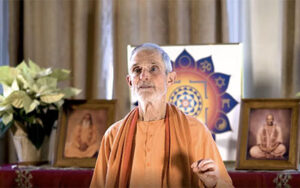 Swami Ramananda is the Executive Director of Integral Yoga Institute in San Francisco, a certified Yoga therapist, and a founding board member of the Yoga Alliance. He leads beginner, intermediate and advanced-level Yoga teacher training programs in San Francisco and teaches throughout the world. Having dedicated his life to teaching Yoga for nearly 50 years, Swami Ramananda is highly-respected senior teacher in the Integral Yoga tradition in Yoga communities worldwide. Swami Ramananda co-developed the Stress Management Teacher Training program with Swami Vidyananda, has trained many teachers to bring Yoga into corporate, hospital and medical settings, and has taught mind/body wellness programs throughout the US and abroad. He is also a co-founder of The Spiritual Action Initiative (SAI) which brings together individuals committed to working for social justice for all beings and for the care and healing of our natural world.