

The “Hand, Head, Heart Ladder.” (Photo montage by Mira Devi)
In this talk, Swami Satchidananda uses practical, experiential language to describe the different dimensions of human life, emphasizing the importance of developing all aspects of our being in an integrated way—Integral Yoga, a complete Yoga.
Each person is a mixture of so many things: there is a physical side, a vital side, a mental, ethical, intellectual and ultimately, a spiritual side. If we really want to lead a better life, a divine life, we should develop all these different aspects within ourselves. It is something like a motorcar: it should be perfect from the motor to the muffler.
Everything in the car—the engine, radiator, battery, tires, brakes—all must be in perfect condition. Last but not least, the spirit—what you call the petrol or gas—must be of good quality too.
People too have many different components. We have the hand, the head and the heart. All begin with the letter “H.” If you put the three H-letters one on top of the other, they make a nice ladder and you can climb up. That is all-round development. You could even divide people into groups this way. The hand-person—the active-temperament person—will always be ready to do something, even before thinking. The head-person, with analytical temperament, for anything and everything will ask what is it, why is it, how is it? The heart-person, the emotional or devotional person, will be guided first and foremost by feelings. Even in the search for God, we come across people of these types.
It is easy to recognize them by the way they act. Suppose these three types are witnessing an accident. The hand-person will immediately spring into action, but if they are too impulsive, it might cause more injury to the victim. The head-person will want to figure out how it happened, who is responsible, and will lose much time in this way. The heart-person will start to cry and may not be able to give any help at all. That is why a person must develop all the three aspects, creating a balance within the personality and equipping us to serve well.
Because Integral Yoga is a complete Yoga, it shouldn’t be one aspect, so it has all its aspects. It offers approaches for the different temperaments. For the active person, there is Karma Yoga. How must the Karma Yogi behave to really be effective? With a neutral mind. Take the example of the apple tree: its job is only to give nice apples—it doesn’t worry whether a person gives praise or throws stones at it, it gives apples to all alike. That is how the Karma Yogi should be. In any action, it is the motive that is more important.
If our motives are for the good of others, without any selfish desires, we are safe from the bondage of that action. That is why it is said that sacrifice is the law of life—tapas (sacrifice, austerity) An active person who does things should always feel this way and should act without selfish motive.
Then, you might wonder, if I don’t think of myself, who will take care of my needs? It is a law of life that the more you live for others, the more others live for you. When you live for the sake of others, you don’t lose anything. That is the glory of a life of sacrifice. That is the path of Karma Yoga.
What about the other types of people then? For the emotional person, there is the path of devotion. That is called Bhakti Yoga. The bhakta praises the glory of God, sings the names of God, and loves the entire world as Divine. Because God is not a person, sitting somewhere in a corner on a high pedestal, giving you commands. No, God is everywhere and is everything. That is why, if we have that kind of vision, we can see God in the entire humanity. By serving our own brothers and sisters, we are serving God. By watering the roots of a tree, we get the fruits on top, isn’t it so? In the same way, by seeing God manifest in everyone, we get the vision of the unmanifest God—Infinite Consciousness.
Divine vision is universal vision, divine love is universal love. Those who call themselves spiritual can never hate anybody or anything in this world. Their heart bleeds at the suffering of others. They are ever ready to offer themselves to make others happy. They forget themselves in divine love and their minds rise above the sense of duality.
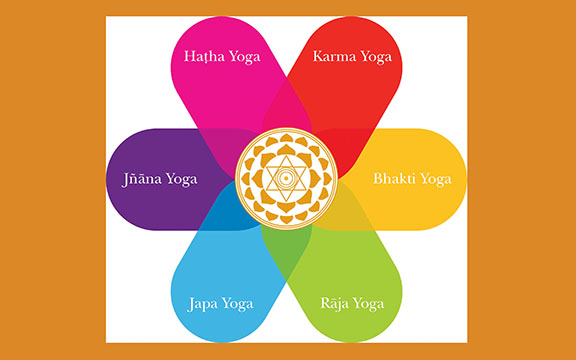
Six branches of Integral Yoga. (Graphic by Shiva Herve)
Now we come to the analytical person. That person should take up Jnana Yoga and analyze the things of this world. Try to find out what is permanent, which things can give lasting happiness. And in this search, you will find that nothing is permanent, everything is changing and all the happiness we have from the outside world is temporary.
For example, you have the thought, “A little ice cream would taste nice.” So, you go out and get some. You eat a little and feel happy. Eat a little more and feel a little happier. Eat still more, and what happens next? All the ice cream comes out, and with it your happiness. If the ice cream has given you happiness, it should give more and more as you add more and more ice cream, should it not? Instead, by trying to get more happiness, you got pain. That is how life goes on from temporary pleasure to temporary pleasure.
Then one day you realize that the real happiness comes from within. As the Bible says, “Blessed are the poor in spirit, for theirs is the kingdom of heaven.” That means: don’t have attachments. It is not the things themselves that give you trouble, but the attachment to them. Knowing that attachment causes pain and detachment causes pleasure, the Jnana Yogi will detach themselves and be free from the botherations of the ego. If nothing is yours, you won’t even say the word “I.” By reflecting on this and detaching from things, the ego gets thinned. It becomes very, very light. And once the ego becomes light, once the ego becomes egoless, the yogi sees that God within. Then you are always happy. Nothing can take that happiness from you.
So, we don’t function in one area alone. Sometimes we think, sometimes we act, sometimes we feel. All the three are needed. When they all work together, when they are well-balanced in our life, only then can we really live a divine life. That is what you call Integral Yoga—simultaneous development of the head, the hand and the heart. Karma Yoga, Raja Yoga, Jnana Yoga and Bhakti Yoga are the path of action, path of concentration and meditation, path of wisdom and path of devotion. Put together it is Integral Yoga. So, they all should go together, work together.
All that we do, all that we feel, all that we think should be converted into divine action. Then the mind is purified. Once the mind becomes pure, egoless, it is easy to control. When the mind has a lot of desires and runs about here and there, uncontrolled, many people say, “I am unable to sit and meditate, even for a minute.” How can you meditate when your mind wants to run here and there? Curb the desires and purify the mind. Then, you can always meditate. You won’t even need to go into a shrine room to meditate. You can meditate in your office, in your factory, in the street, anywhere and everywhere. Your life will be a constant meditation. Allow a part of the superficial mind to act for you in the world and keep another portion of the mind dwelling on the deep inner Self. That is what you call a Jivanmukta—a person who is living in the world and yet liberated. That is the real happiness, the real peace, the real freedom.