

Photo: The Rainbow Yoga founding family; (photo courtesy of the Rainbow Yoga archive)
Imagine a children’s Yoga class becoming a constellation. Arms spread into stars. One child’s star is tiny, made with two fingers. Another stands firmly on the floor. Then somebody announces, “My star is going to sleep.” A teacher could correct the astronomy: stars do not sleep, and this was not the planned pose. Or we could notice that an unexpected invitation has appeared. Does the class have room for one child’s sleeping star without everyone else having to orbit it?
Yoga offers us a demanding answer. Its ethical teachings are not decorations on a well-behaved class. The yamas, often described as ways of living responsibly with others, ask what we do with our wishes when they meet another person’s needs. In children’s Yoga, these questions can take the wonderfully untidy form of a shared game.
A class can teach physical shapes while missing the larger practice entirely. A child may hold a beautiful balance while ignoring a partner’s request to stop. Conversely, a child sitting at the edge, able to say “not yet” and have it respected, may be participating in something profoundly yogic. These are suggested activities for primary-age children, roughly six to ten, rather than accounts of specific pupils or promises of outcomes. Adapt them to the children, access needs and setting. The adult remains responsible for safety and for interrupting harm.
Ahimsa: the pause is a pose too
Ahimsa, non-harming, sounds straightforward until a child is eager to demonstrate a brilliant new partner pose. Their enthusiasm is real. So is their partner’s hesitation. What happens next is the lesson.
Try a mirror duet without touching. One child slowly moves an arm or turns their shoulders; the other chooses whether and how to follow. Eye contact is optional. Agree beforehand on an accessible pause signal, spoken or gestured, and practise it together. When either child signals, both stop. Not “just one more time.” Not “but we were nearly finished.” Stop. In that small silence, a principle becomes physical. Care is not what we claim to feel for someone; it is how our behaviour changes when we discover their limit. The leader can make a movement slower, smaller, seated or completely different. A child who prefers to move alone may do so without being turned into the class’s lesson in cooperation.
Non-harming also includes adults. It is easy to mistake the achievement of a tidy class for everyone’s wellbeing. If a child is overwhelmed, an impressive group photograph would be a poor consolation prize. Ask whether the activity still serves those doing it.
Satya: the freedom to mean no
Satya is truthfulness, but children need more than a lecture on honesty. They need to know that telling the truth will not automatically make an adult disappointed or a peer offended.
Invite partners to choose an ending for their mirror duet. One wants matching tree poses; the other would rather sit and make a small bow. The temptation is to coax agreement so the lesson can move along. Instead, ask each child what they actually want and what they can comfortably offer. Perhaps they choose different poses with the same rhythm. Perhaps each makes a solo ending. Perhaps no duet happens today.
An honest “no” is information, not a malfunction. When we encourage children to listen to their bodies, we also need to respect what they tell us. Truthfulness belongs to teachers, too. If a suggested mountain pose involves climbing unstable furniture, say clearly that it is unsafe. Then honour the idea behind it: “You want a really tall mountain. How could we make it feel enormous while staying on the floor?” We need not pretend an unsafe plan is safe, nor treat imagination as the enemy of boundaries.
And when we interrupt someone too quickly, satya may sound remarkably unglamorous: “I cut you off. I am sorry. What were you saying?” The apology is more convincing than a ten-minute talk about respect.

Photo courtesy of Rainbow Yoga archive.
Aparigraha: loosen the grip on our brilliant ideas
Aparigraha is commonly understood as non-grasping or non-possessiveness. Children may not need the Sanskrit word to recognise its difficulty. Anyone who has watched three people argue over who gets to be the dragon knows that attachment can arrive wearing paper wings.
Build a Yoga garden together. Invite one child to become a tree, another a flower, another a stream. Others may sit, draw, describe an idea or watch before joining. The group has a real challenge: make a place in which these contributions can coexist. If the stream takes every inch of floor, ask, “Where could the river flow so the flower has room?” If one child’s thunderstorm has swallowed the entire story, invite weather from someone else. Make sure quieter children have ways to contribute beyond competing to speak fastest.
Then create a little sequence: tree opens its branches, flower unfolds its hands, stream flows gently. Repeat it once, and ask for one change. The practice is not simply remembering movements. It is remembering that an idea can be precious without having to be permanent or exclusively ours. This applies most sharply to the teacher. We arrive with a lesson plan that took thought and care. Then a child says, “My tree is a spaceship.” Can we preserve the group’s safety and purpose without clinging to our exact script? Non-attachment is not abandoning structure. It is knowing which parts of structure are useful and which parts are merely our preference dressed up as necessity.
The yamas are not a politeness contest
Ethics can become another way to reward compliant children unless we are careful. A quiet child is not necessarily peaceful. A child who says no is not automatically unkind. And a child whose needs differ from the group has not failed a Yoga test.
When two children reach for the same scarf, do not rush to crown the one who gives it up “the most yogic.” A fair solution might be taking turns, using two different materials, or changing the game so nobody has to wait on the sidelines. Non-harming asks who is affected. Truthfulness asks what each person needs. Non-grasping asks what we can loosen. Sometimes those questions pull in different directions. That is why this is practice rather than performance.
We should also be honest about power. Children do not carry equal responsibility for fixing an unsafe group. Adults must stop hurtful behaviour directly, ensure access, and make genuine options available. Yoga’s ethical teachings should deepen our care, not give us elegant language for leaving children to negotiate their own protection. The funny thing is that seriousness is not a requirement. A snoring sunflower, a confused butterfly and a river taking an ill-advised shortcut through the cabbage patch can offer plenty of material. Laughter need not weaken ethics. It may help a group stay curious enough to practise them again.
Take the practice off the mat
Close with a quiet moment sitting, standing or resting as each child prefers. Ask one question: “What did someone else do that helped you join in?” Passing is fine. Note a practical suggestion and, next time, show what changed. If a request cannot be met, explain why. There is a difference between teaching children to recite kindness and building a space where their choices actually matter. A partner signals pause; we pause. Someone tells us the truth; we listen. A beloved plan stops working; we loosen our grip and begin again.
Yoga does not end at the edge of the mat. Sometimes it begins at the exact moment our favourite idea has to make room for somebody else’s sleeping star.
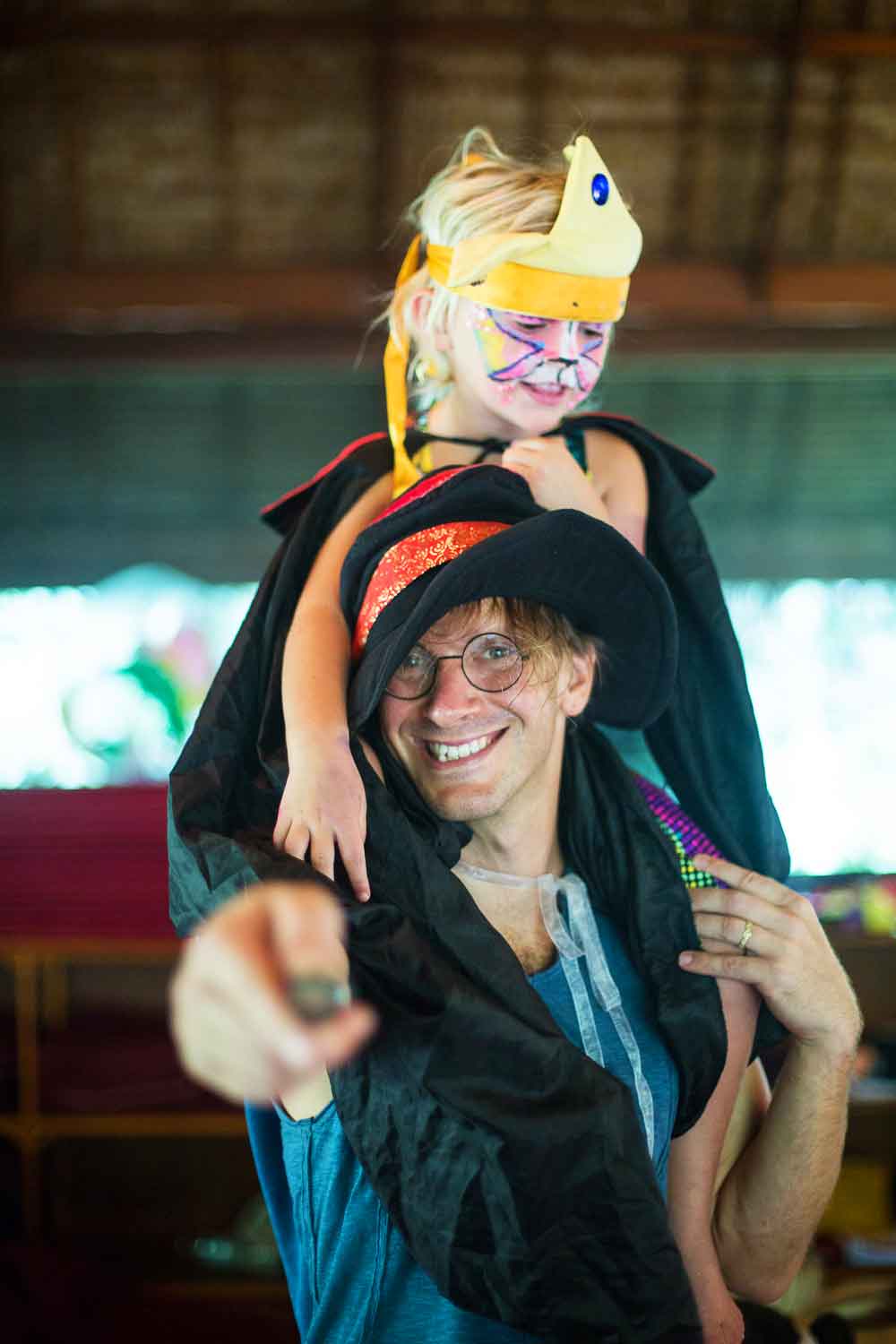
Gopala Amir Yaffa
About the Author:
Gopala Amir Yaffa is founder and co-director of Rainbow Yoga. His work in children’s and family Yoga focuses on playful connection, shared movement and creating meaningful choices for children and adults. This article adapts ideas from Rainbow Yoga’s previously published “We Ask Children to Listen to Their Bodies. Are We Listening to Their Voices?” Activities are suggested teaching practices, not reports of specific observed classroom episodes.