
 Sharon Salzberg, the popular meditation teacher and co-founder of the Insight Meditation Society, recently wrote an article for Tricycle magazine on voting, meditation, and how to counteract despair through changing the system. During these challenging times, Tricycle is kindly making this, and other selected articles, available for non-subscribers to read.
In the online forums I’ve been involved in, the virtual workshops hosted by groups all across the country, people often have described feeling powerless. Confined as many of us are [due to the Covid-19 pandemic], experiencing so many pent-up feelings in these aggressive and confounding times, people often find it hard to know where to channel our energy. In the face of immense problems, we can be frozen by the question, what in the world can I do? Any possible action seems so small, so insufficient.
In a forum in early September 2020, a participant presented me with this exact dilemma. He was attending from a city where tensions were high around a police shooting. The night before, he had attended a demonstration that turned violent when the police shot tear gas and rubber bullets at the protestors. He felt angry, frightened, and more than anything he felt hopeless. He asked if I could talk about how we use our practice in moments like this. This man spoke for many, we could see, as advice and support for him lit up in the chat.
We then explored how meditation is a tool that helps us to look more deeply within when we feel the pain of our connection to the world. Meditation helps us sit with powerful emotions yet avoid two extremes—being overcome or defined by them, or trying to push them away. The more we try to tamp down or deny the anger or grief we feel, the stronger they get. Our challenge lies in honoring the message of the emotions and channeling the energy they contain without letting them consume us. In Buddhist psychology, anger is likened to a forest fire that burns up its own support. That means the anger can destroy the host. READ FULL ARTICLE AT TRICYCLE.ORG
About the Author:
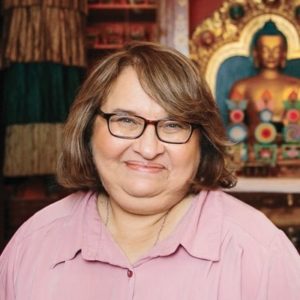 Sharon Salzberg has been a student of Buddhism since 1971 and has led meditation classes and retreats, worldwide, since 1974. She teaches both intensive awareness practice (insight meditation) and the profound cultivation of lovingkindness and compassion in a non-sectarian, inclusive framework. She is a co-founder of the Insight Meditation Society in Barre, Massachusetts and The Barre Center for Buddhist Studies. She is the author of eleven books including Lovingkindness, the NY Times best seller Real Happiness, and Real Love: The Art of Mindful Connection. Her latest book, Real Change: Mindfulness To Heal Ourselves and the World, just came out in September of 2020 from Flatiron Books. For more information: www.sharonsalzberg.com.