

Photo: Integral Yoga Hatha Teacher and Doctor of Ayurveda, Cory Tixier.
There are moments along our path when something new enters our lives and, strangely, feels less like a discovery than a remembering. That is how Ayurveda came to me. My formal path into Yoga began at Satchidananda Ashram–Yogaville in 2009, where I completed my 200-hour Integral Yoga Teacher Training. Arriving at Yogaville felt a little like being pulled into the mothership. There was something immediately familiar about it, even though so much of what I was learning was new.
My experience there was profound—not only intellectually or spiritually, but in the most embodied and human ways. During my teacher training, I was injured and incapacitated for several days. At the time, I was camping at Yogaville. Suddenly, I couldn’t simply continue with the training as planned. I remember praying for support. And support came. The community moved me out of my tent and into a room. People checked on me. People brought what I needed. Practitioners offered treatments and care. I experienced, in a very tangible way, what it meant to be held by a spiritual community.
Looking back, I sometimes wonder whether that experience taught me as much about Yoga as anything that happened in the classroom. Yoga was no longer simply something we practiced. It was how people responded. My teacher during that training was Swami Asokananda, whom I still consider my Yoga teacher today. Though I haven’t always been able to study with him in a structured way over the years, that relationship and the teachings I received through Integral Yoga have remained an important thread throughout my life and work. And then, just as my teacher training was ending, another thread appeared.
When Ayurveda Found Me
A teacher named Mukunda Stiles happened to be arriving at Yogaville to offer a weeklong introduction to Ayurveda. At that time, I knew very little about Ayurveda. I knew it existed. I knew I was curious about it. And somehow, I could already sense something of it inside what I had been learning through Yoga. So, I stayed. I couldn’t have explained it then the way I can now. It was more of a knowing than an understanding: Yoga and Ayurveda belonged together. Somehow, each held a piece of something I needed to understand more completely.
Ayurveda eventually led me to New Mexico in 2011, where I studied deeply with Dr. Vasant Lad at The Ayurvedic Institute. In time, I went from being a student there to teaching extensively, developing curriculum, working clinically, and helping create and oversee educational and Panchakarma programs in India. What began as one extra week at the end of my Yoga teacher training became the work of my life.
Yet the deeper I traveled into Ayurveda, the more I found myself returning to Integral Yoga. The two were never really separate.
Two Sciences, One Conversation
We often describe Yoga and Ayurveda as “sister sciences.” It is a useful phrase, but after years of living and teaching both traditions, I have come to experience their relationship as something even more intimate. They are speaking to different dimensions of the same human being. Yoga invites us to examine the nature of mind, Consciousness, suffering, and liberation.
Ayurveda asks us to become exquisitely aware of the conditions through which Consciousness is living: this body, this nervous system, this digestion, this season, this stage of life, this particular moment. Yoga teaches us to observe the fluctuations of the mind. Ayurveda makes us curious about the ground beneath those fluctuations.
How did you sleep? What have you eaten? What is happening with your digestion? What season are you living in? What qualities have accumulated in the body and mind? What does your system need now? This is one of Ayurveda’s great gifts to the Yoga practitioner: it teaches us to perceive relationship. Digestion and thought. Sleep and mood. Breath and nervous system. Environment and physiology. Daily rhythm and longevity. The parts of ourselves that we are accustomed to separating begin to reveal themselves as a living conversation.
The broader Indian wisdom traditions widen this conversation even further. Jyotisha turns our attention toward our relationship with time and celestial rhythms. Vastu considers our relationship with space, place, and environment. Yoga turns inward toward mind and Consciousness. Tantra offers still other ways of understanding embodiment, energy, and realization. These traditions are distinct, with their own histories and methods, but there is a shared invitation within them: to understand ourselves not as isolated beings, but as participants in relationship with life.
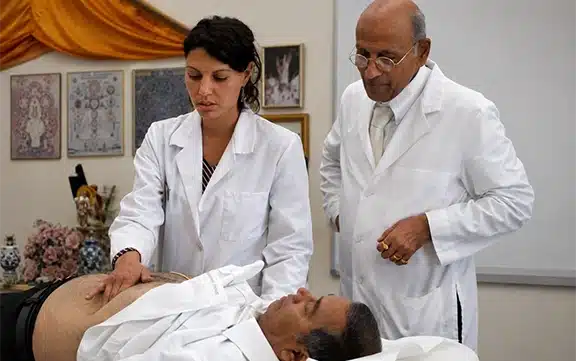
Photo: Clinical training with Dr. Vasant Lad.
Ayurveda Was Already in the Family
Eventually, my path circled back to Integral Yoga. After graduating from The Ayurvedic Institute, I reconnected with Swami Asokananda in winter 2013, and from that reconnection grew a wonderful relationship between my Ayurvedic work and the Integral Yoga community. There was a tremendous sense of coming home.
Over the years that followed, I had the privilege of sharing Ayurveda within the Integral Yoga Institute of New York community in many different ways: from workshops, long-weekend programs, and day retreats to Ayurvedic consultations and treatments in the Wellness Center, Sanskrit teaching within Yoga Teacher Trainings, and eventually helping develop and teach the larger Ayurvedic Health Counselor program.
And as these worlds came back together, something became increasingly meaningful to me. Ayurveda was not actually something we were bringing into Integral Yoga from the outside. The thread was already there. Our beloved Swami Satchidananda met his Guru, Sri Swami Sivananda, in Rishikesh in 1949 and received sannyas from him.
Before becoming Swami Sivananda, he had been Dr. Kuppuswami, a physician with an intense desire to serve. And even very early in his medical life, we can see the threads beginning to weave together. In 1909, while still a young medical man, he began publishing a journal called Ambrosia. He wrote articles himself and actively sought contributions from Ayurvedic physicians. Health, hygiene, diet, medicine, and the teachings of India’s sages appeared alongside one another in its pages. I love that detail. Long before the language of “integrative medicine” existed, the impulse toward synthesis was already there.
After practicing medicine in Malaya and later taking sannyas, Swami Sivananda never abandoned his concern with the health of the body. He continued to write extensively on medicine, diet, healing, Yoga, and spiritual life. His book Practice of Ayurveda is a substantial exploration of Ayurvedic principles: from dosha, digestion, and diet to herbs, psychology, rejuvenation, and therapeutics. At his ashram in Rishikesh, he established the Sivananda Ayurvedic Pharmacy in 1945 alongside other forms of medical service.
Yet what interests me most is not simply that he knew or wrote about Ayurveda. It is the place health held within his larger vision. For Swami Sivananda, health was not an end unto itself. Throughout his writings, he returned again and again to the idea that the body is the instrument through which we serve, practice, meditate, and seek realization. Caring for that instrument supports sadhana. There it was. The relationship I had somehow sensed but could not yet name when I stayed for that Ayurveda course at Yogaville all those years ago.
Yoga and Ayurveda weren’t competing for my attention. Ayurveda could help care for the instrument through which Yoga was being practiced. And for those of us who come through Integral Yoga, this is especially beautiful. Ayurveda isn’t simply another system we might choose to add to our Yoga practice. There is an Ayurvedic thread within the life and teachings of Swami Satchidananda’s own Guru. Perhaps it is one of the quieter threads of our inheritance—one that has been there all along, waiting for us to pick it up again.
Taking Yoga Off the Mat
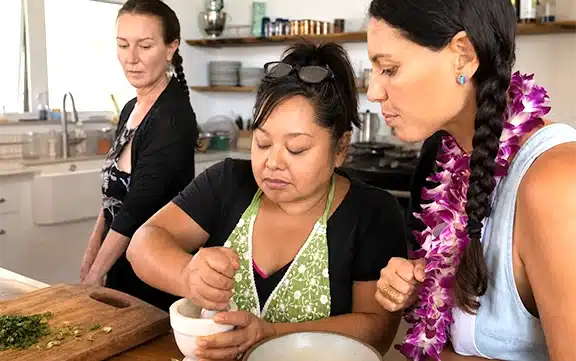
Photo: Proper food prep is part of Ayurvedic science.
Once we begin looking through this lens, even the Yoga practices we know so well start to become new again. Consider asana. From an Ayurvedic perspective, an asana doesn’t simply stretch a muscle or strengthen a joint. It carries qualities, and those qualities affect the whole organism. Is the practice heating or cooling? Mobilizing or grounding? Expansive or containing? What is happening to prana? Which marma points are being engaged? How might the sequence affect agni? What happens to the doshas, Vata, Pitta, and Kapha? Why might the same practice leave one person centered and another depleted?
Suddenly, our familiar Hatha Yoga practice becomes dynamic again. Instead of repeating the same practice simply because it is “our routine,” we begin to listen. What do I need today? This isn’t an abandonment of discipline. It is a refinement of it. The practice becomes alive enough to meet the practitioner. Our morning practice might need to change with the season. Pranayama that serves us beautifully during one period of life may need to soften during another. A vigorous practice may be exactly what one constitution needs and precisely what another needs less of. We begin to understand not only what we are doing, but how and why it is affecting us. And the same inquiry continues when we roll up the mat.
Ayurveda’s daily practices, dinacharya, ask us to consider how we wake, eliminate, nourish ourselves, work, move, rest, and sleep. We begin to see that the conditions we create during the other twenty-three hours of the day have something to do with what happens during the hour we call our Yoga practice. Longevity, in Ayurveda, isn’t simply about accumulating more years. It is cultivated through our relationship with life, one day at a time. In that sense, dinacharya is profoundly yogic. It asks us to practice awareness when no one is leading the class. Perhaps that is also why the experience of being cared for at Yogaville stayed with me so deeply. Before I had the language of Ayurveda, I had already experienced something essential about healing: the whole being exists in relationship.
Another Homecoming
The pandemic changed so many communities and relationships, and for several years my active work with Integral Yoga became quieter. Now another circle seems to be completing. I’ve been invited to reconnect with the Integral Yoga Institute of New York. And it’s given rise to another realization. How do we understand more fully what we have already been given?
Nearly two decades after that young Yoga teacher stayed at Yogaville for one more week because something inside her said, You need to learn this, I am still exploring that question. And perhaps that is part of what lineage does. It gives us threads of wisdom that we may spend a lifetime discovering, following, losing, remembering, and weaving back together. Sometimes the path takes us far away in order to teach us something. And sometimes, if we are fortunate, it brings us home again.

Cory Tixier
About the Author:
Cory Tixier is a NAMA-certified Ayurvedic Doctor, Ayurvedic Yoga Therapist, Licensed Massage Therapist, educator, and mentor whose work has been shaped by decades of disciplined study, clinical practice, teaching, and service. Her immersive training began at the Ayurvedic Institute in New Mexico under Dr. Vasant Lad. Today, she serves clients, mentors practitioners, and teaches from the North Shore of Oʻahu. corytixier.com
Cory will be teaching a three-part online workshop series through the Integral Yoga Institute of New York in October, November, and December entitled Yoga Beyond the Mat, exploring Ayurveda and its deep relationship with Integral Yoga. For more information, visit www.iyiny.org